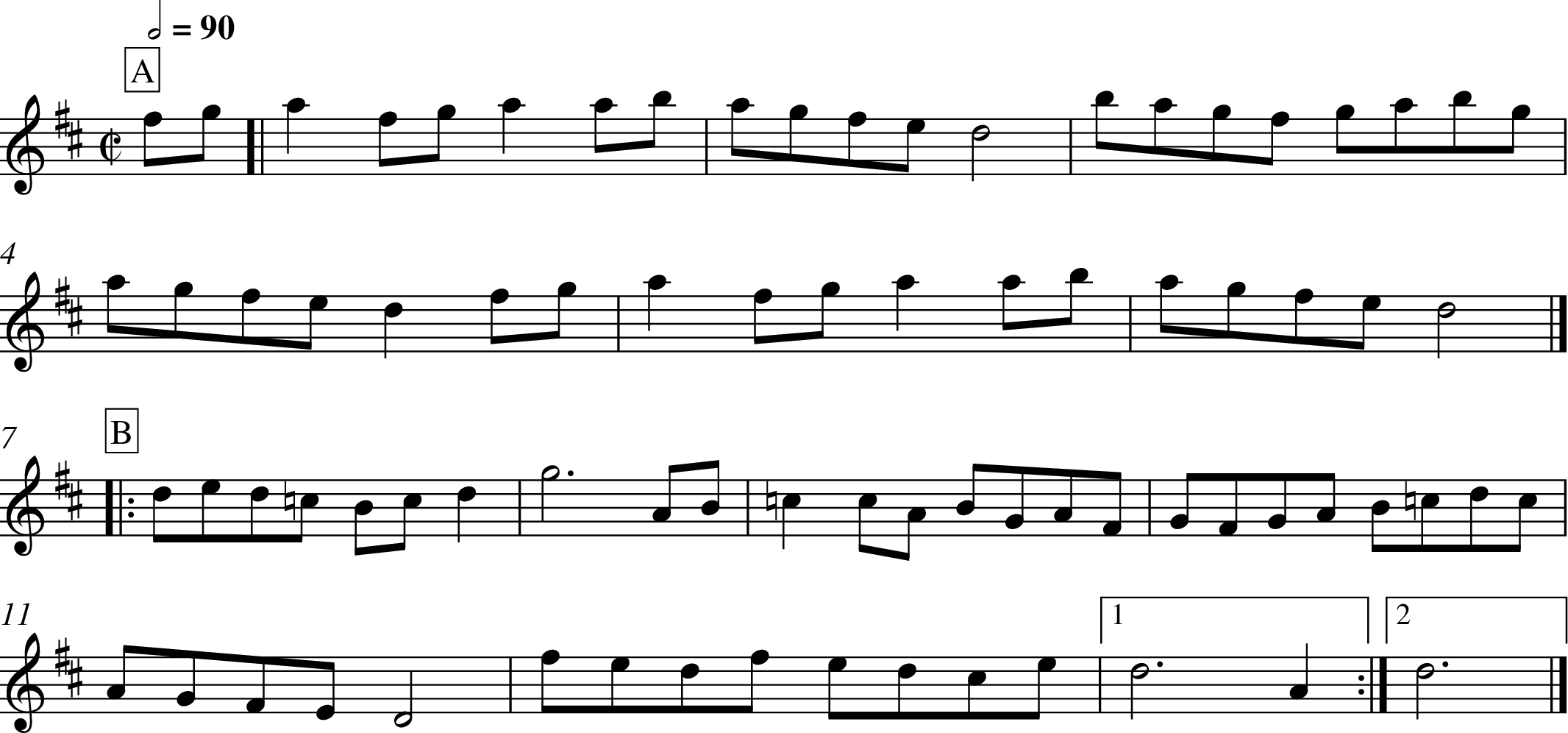
I love this tune. It's quite irregular but it doesn't sound irregular, it just works. What a fully joyous melody. And what a great name for a tune, eh?
Notice: no repeats in the A part, that's not a mistake.
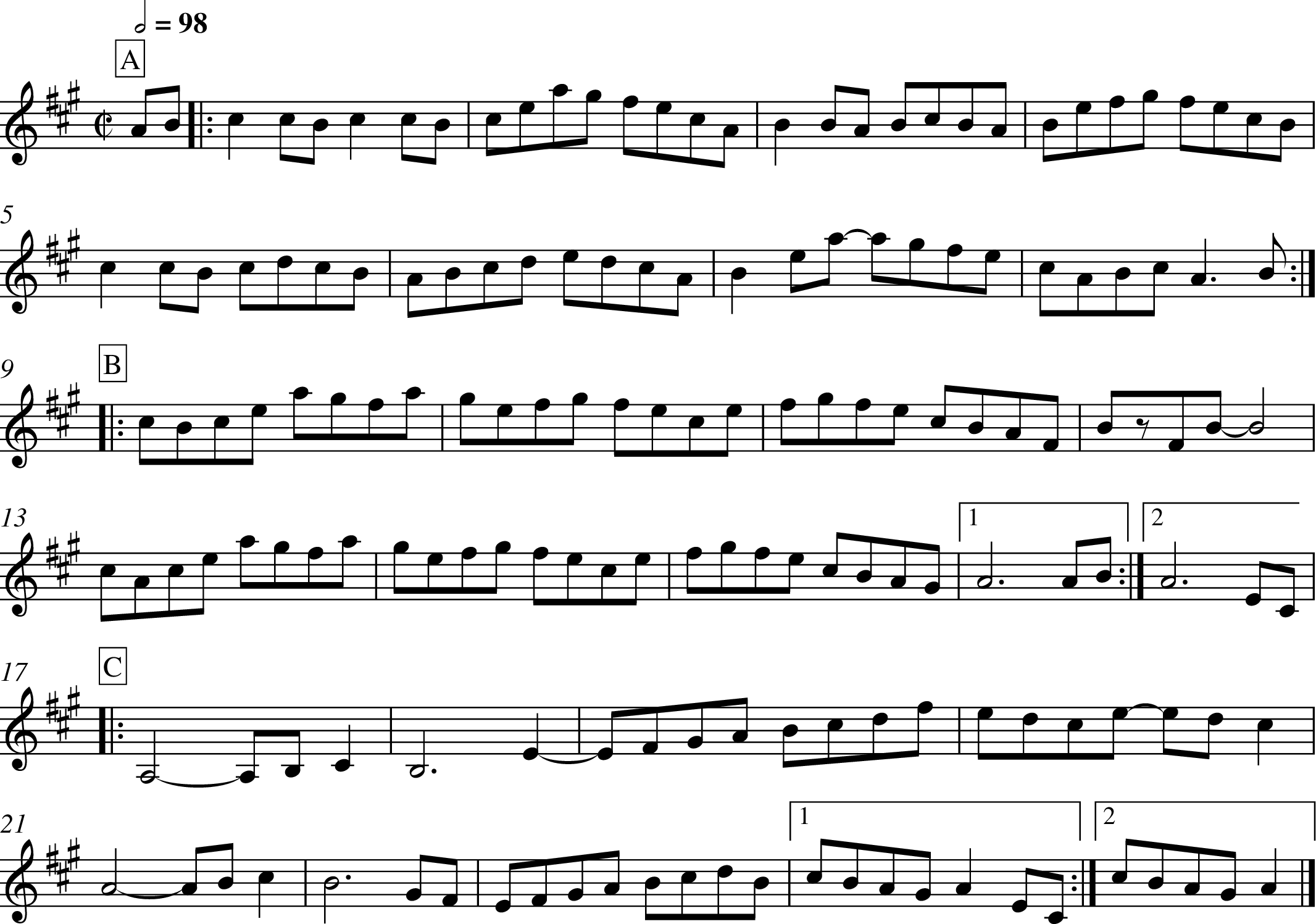
This spiky reel was recorded in Texas in 1929 by the Lewis Brothers, and it's been played and recorded by many people since then. I learnt it from my dad, who played it on the fiddle. I think, as a result, my version is a little spikier than the way most people play it, while also closer to the 1929 recording, but that's pretty subjective. It always feels to me like a crooked tune, and I have to count to remind myself that it's totally straight.
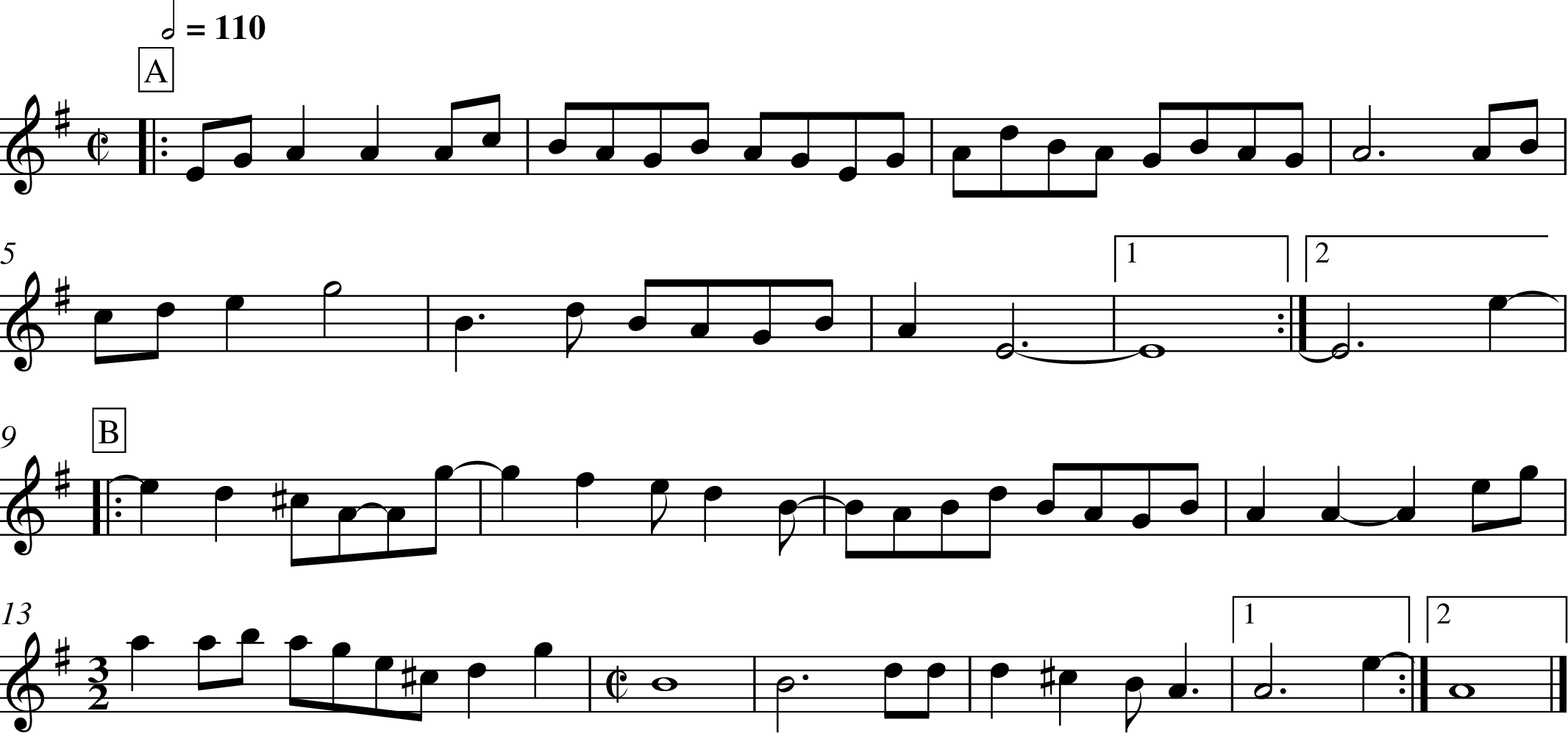
This is a tune by Andrew Marlin, from his terrific 2018 album "Buried in a Cape". It's not difficult for the fingers, but there's lots of syncopation and anticipation. That's what gives it its charm, of course, but it can also make it trickier to learn.
I've left the long E notes at the end of the [A] section alone, but you probably wouldn't want to play them that way very often. There are lots of little fills and tricks and things you can do to ornament that space. Definitely start by listening to Andrew Marlin himself play it!
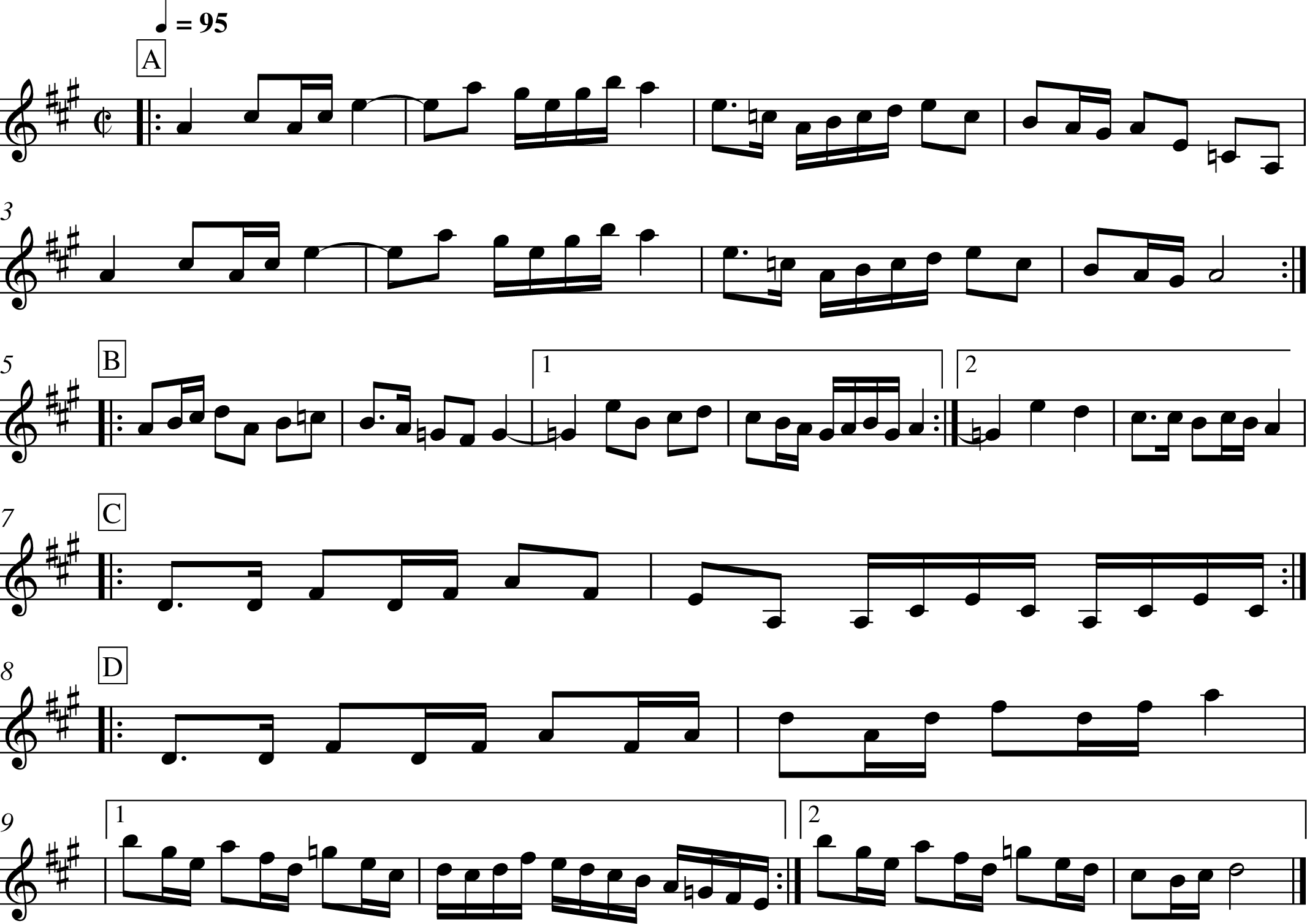
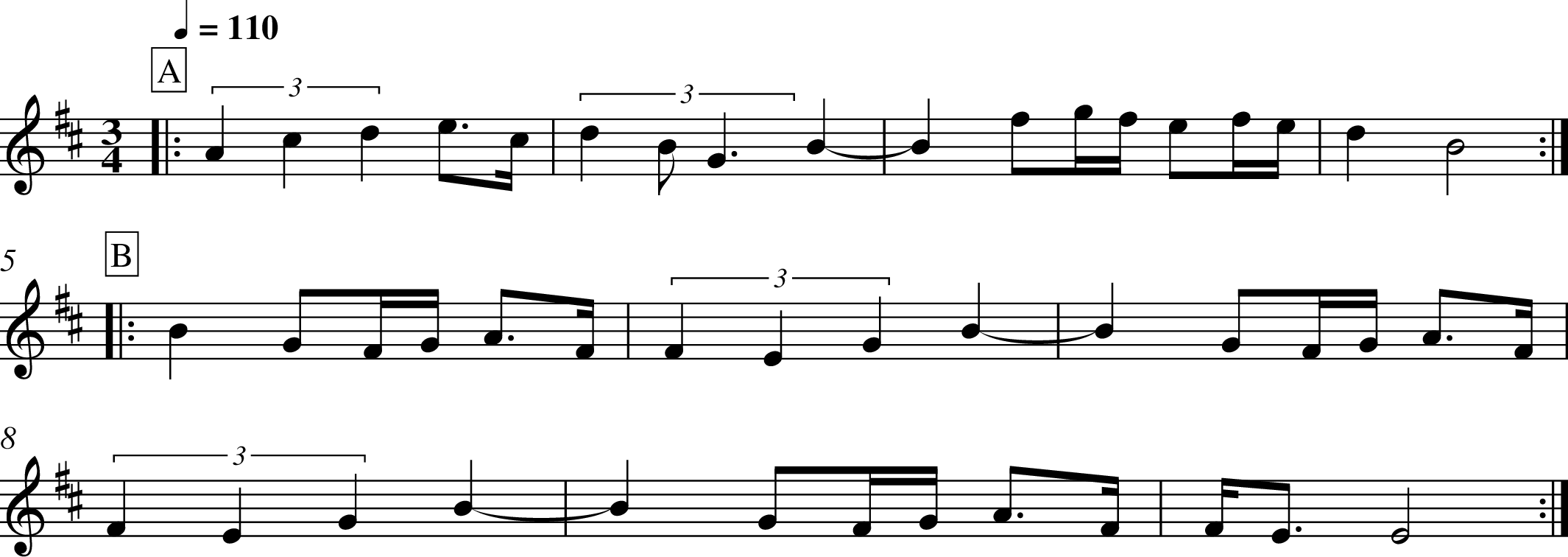
This is a lovely big polska. Lots of shifts of tonality, but on the other hand the rhythm is pretty straight.
This tune looks a little simple and repetitive written down. It's not complicated at all, apart from being a polska, but there is so much that can be done with it. I first heard it on the 1989 album by Simon Simonssons kvartett, Längs gamala stigar och färdevägar, and they turn this little tune into a jewel.
I've transcribed it in D Major just to avoid accidentals, but it doesn't seem to me to spend much time actually in D.
The second part does a little XXY thing I really like, that always reminds me of the trilithons at Stonehenge: a short phrase that's played twice like the sarsen stones, then a single short phrase to cap them off, like the lintel stone.
Finally: it's a polska, the beats are not all the same length: please please please don't try and play it without listening to Simon Simonsson's Quartet first. I've tried using triplets to express the rhythm of some bars, do you think it works?
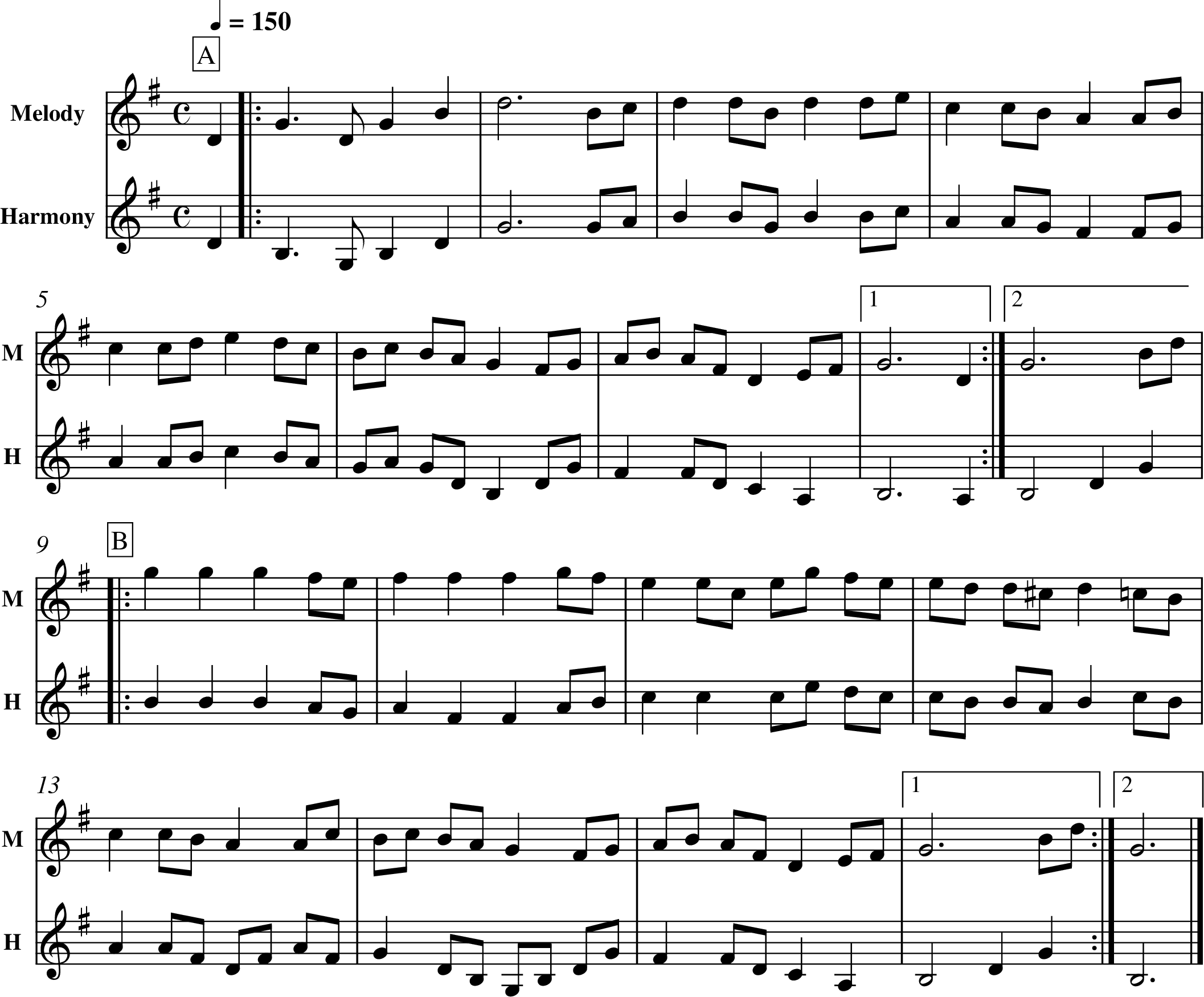
This is a very popular tune in Sweden, and relatively well-known elsewhere. One of those tunes that probably gets overplayed because it's really good.
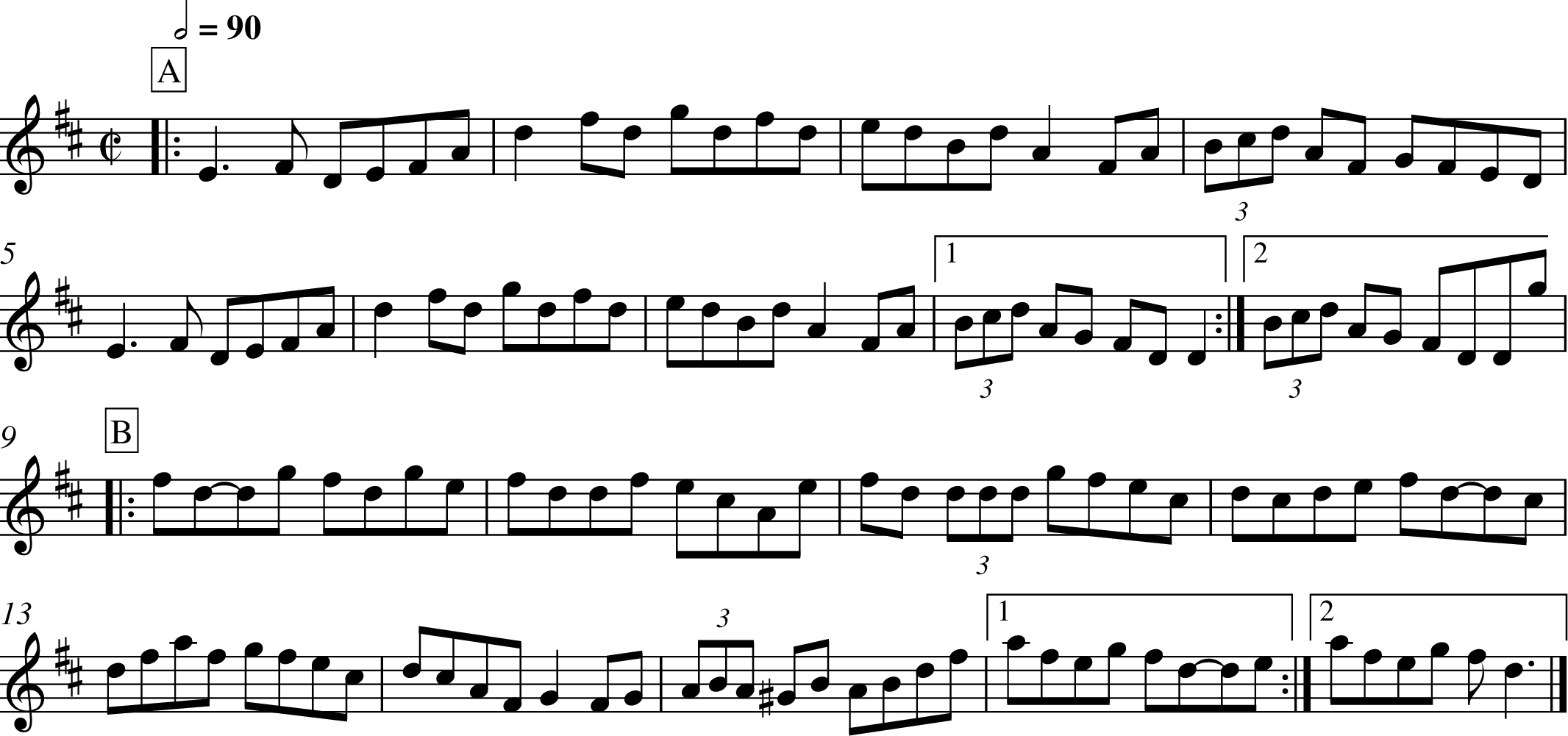
This is another tune which I first heard on the album Traditional Music From Ireland by Séamus Creagh and Aidan Coffey. There's not a bad track on that album, by the way. The tune was composed by John McGrath, some time in the 1920s or '30s, and it's sometimes called the Rossport Reel, after his birthplace.
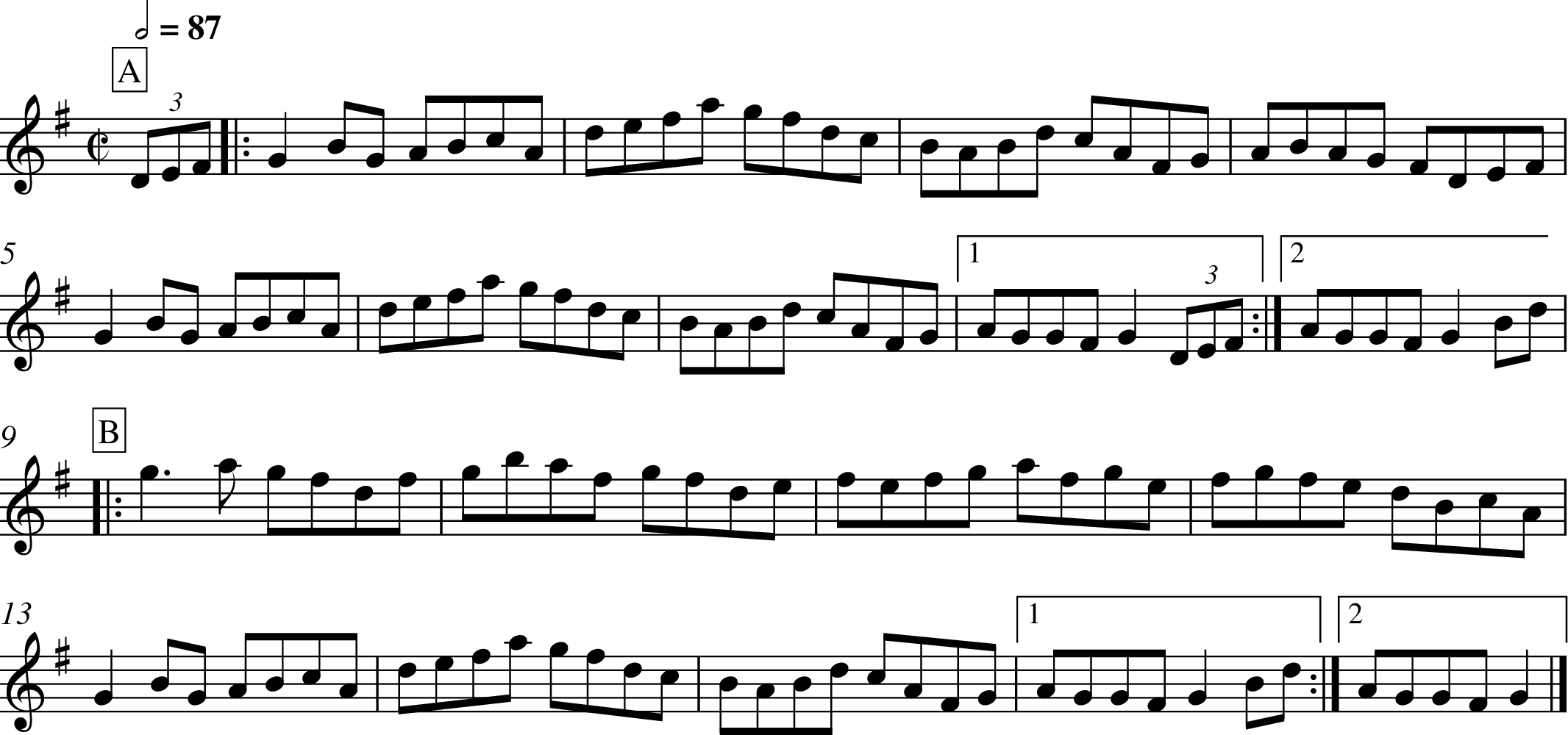
I got this brilliant sparkling reel from anglo concertina player Mandy Murray in Brighton.
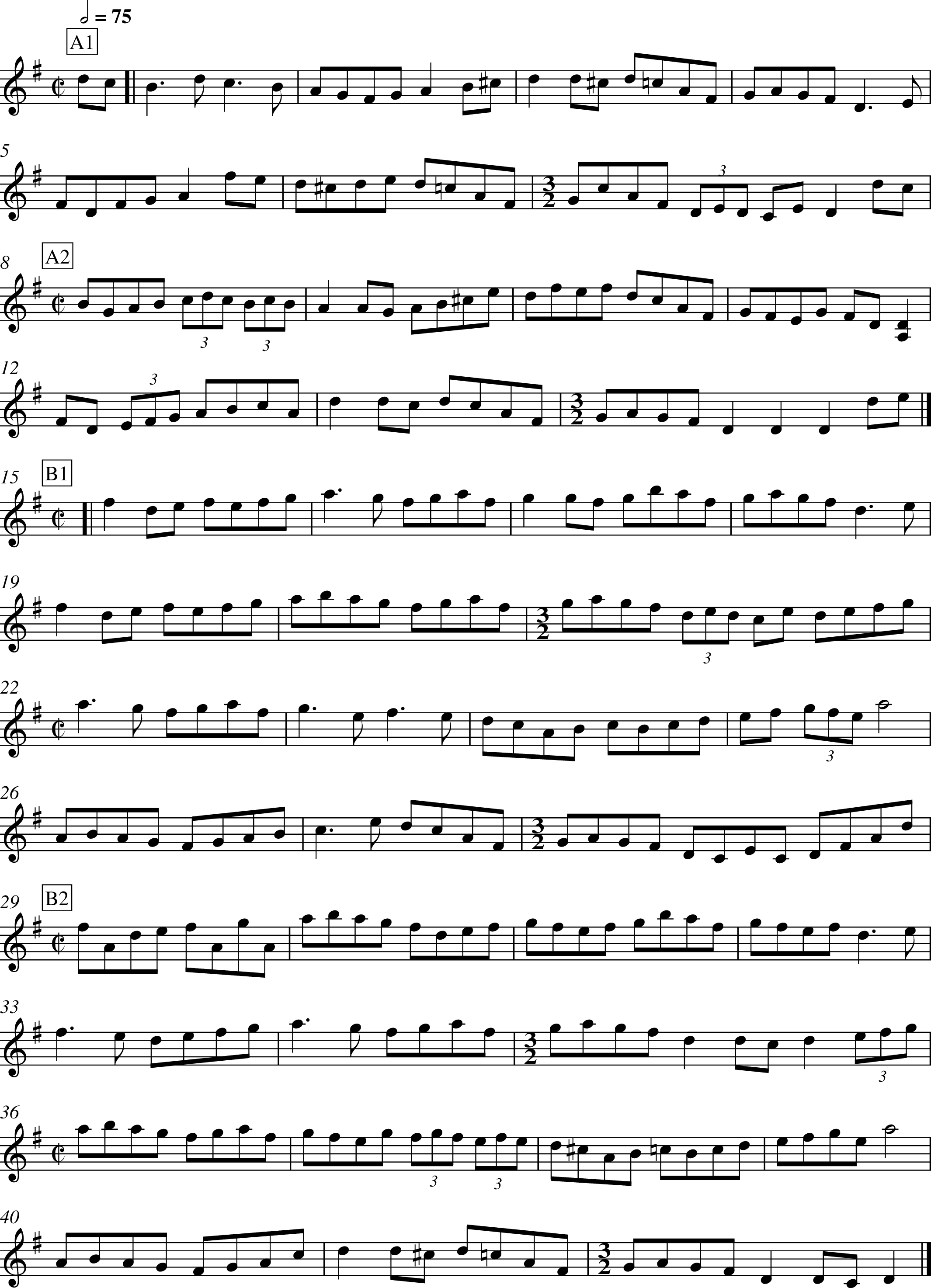
This tune is so amorphous, it's hard to write down because there are just so many different things to do. When John Carty plays it, it's almost unrecognisable at times from the sheer exuberance of his variations and as for Tommy Potts' version, I'm not even completely sure it's the same tune. I've chosen to write it here without repeats so as to include a couple of different ideas. It's not just an Irish tune, you'll hear versions of it from all around these islands, and there's even an American version called "Queen of The Earth and Child of the Skies".
%%abc-version 2.1
%%abc-copyright (C) Copyright Ben Paley 2026
%%writefields N
%%writefields D
%%measurenb 0
%%partsbox 1

X:1
T:Ship In The Clouds
L:1/8
M:C|
C:Trad arr. ©2026 Ben Paley
N:I love this tune. It's quite irregular but it doesn't <em>sound</em> irregular, it just works.
N:What a fully joyous melody. And what a great name for a tune, eh?
N:Notice: no repeats in the A part, that's not a mistake.
Q:1/2=90
R:Reel
D:Andy Cahan, Laura Fishleder and Lisa Ornstein, "Ship in the Clouds", 1978
Z:Ben Paley <ben.paley@benpaley.com>
K:D
P:A
fg [| a2fg a2ab | agfe d4 | bagf gabg |
agfe d2fg | a2fg a2ab | agfe d4 |]
P:B
[|: ded=c Bcd2 | g6 AB | =c2cA BGAF | GFGA B=cdc |
AGFE D4 | fedf edce |1 d6 A2 :|2 d6 |]
X:2
T:Bull at the Wagon
L:1/8
M:C|
C:Trad arr. ©2026 Ben Paley
N:This spiky reel was recorded in Texas in 1929 by the Lewis Brothers, and it's been played and
N:recorded by many people since then. I learnt it from my dad, who played it on the fiddle. I
N:think, as a result, my version is a little spikier than the way most people play it, while also
N:closer to the 1929 recording, but that's pretty subjective. It always feels to me like a
N:crooked tune, and I have to count to remind myself that it's totally straight.
O:New Mexico/Texas, USA
Q:1/2=98
R:Reel
Z:Ben Paley <ben.paley@benpaley.com>
K:A Major
P:A
AB |: c2 cB c2 cB | ceag fecA | B2 BA BcBA | Befg fecB |
c2 cB cdcB | ABcd edcA | B2 ea- agfe | cABc A3B :|
P:B
|: cBce agfa | gefg fece | fgfe cBAF | BzFB- B4 |
cAce agfa | gefg fece | fgfe cBAG |1 A6 AB :|2 A6 EC |
P:C
|: A,4- -A,B,C2 | B,6 E2- | -EFGA Bcdf | edce- -edc2 |
A4- -ABc2 | B6 GF | EFGA BcdB |1 cBAG A2EC :|2 cBAG A2 |]
X:3
T:Trips Around the Sun
L:1/8
M:C|
C:©2018, Andrew Marlin
N:This is a tune by Andrew Marlin, from his terrific 2018 album "Buried in a Cape". It's not
N:difficult for the fingers, but there's lots of syncopation and anticipation. That's what gives
N:it its charm, of course, but it can also make it trickier to learn.
N:I've left the long E notes at the end of the [A] section alone, but you probably wouldn't want
N:to play them that way very often. There are lots of little fills and tricks and things you can
N:do to ornament that space. Definitely start by listening to Andrew Marlin himself play it!
Q:1/2=110
R:Reel
D:Andrew Marlin, "Buried in a Cape", 2018
Z:Ben Paley <ben.paley@benpaley.com>
K:A Dorian
I:linebreak $
P:A
|: EG A2 A2 Ac | BAGB AGEG | AdBA GBAG | A6 AB |$
cd e2 g4 | B3d BAGB | A2 E6- |1 -E8 :|2 E6 e2- |$
P:B
|: -e2 d2 ^cA-Ag- | -g2 f2 ed2B- | -BABd BAGB | A2 A2- -A2 eg |$
M:3/2
a2 ab age^c d2g2 |
M:C|
B8 | B6 dd | d2^c2 BA3 |1 A6 e2- :|2 A8 |]
X:4
T:Skrammelpolskan efter Karl Lindblad
T:Rattle-polska from the playing of Karl Lindblad
L:1/16
M:C|
C:Trad arr. ©2026 Ben Paley
N:This is a lovely big polska. Lots of shifts of tonality, but on the other hand the rhythm is
N:pretty straight.
O:Gästrikland, Sweden
Q:1/4=95
R:Polska
D:Tony Wrethling, Ulf Hermansson and Per Börjesson, "Felan Går - Danslåtar från
D:Gästrikland", 1979
D:Sven Ahlbäck, "Gästriketon", 1981 (as "Polska efter Karl Lindblad")
Z:Ben Paley <ben.paley@benpaley.com>
K:A
P:A
|: A4 c2Ac e4- | -e2a2 gegb a4 | e3=c ABcd e2c2 | B2AG A2E2 =C2A,2 |
A4 c2Ac e4- | -e2a2 gegb a4 | e3=c ABcd e2c2 | B2AG A8 :|]
P:B
|: A2Bc d2A2 B2=c2 |  B3A =G2F2 G4- |1 =G4 e2B2 c2d2 | c2BA GABG A4 :|2 =G4 e4 d4 | c3c B2cB A4 |
P:C
|: D3D F2DF A2F2 | E2A,2 A,CEC A,CEC :|
P:D
|: D3D F2DF A2FA | d2Ad f2df a4 |
|1 b2ge a2fd =g2ec | dcdf edcB A=GFE :|2 b2ge a2fd =g2ed | c2Bc d8 |]
X:5
T:Faut Margit lieken efter Einar Britt
T:Margit the Bailiff's tune (?) from the playing of Einar Britt
L:1/16
M:3/4
C:Trad arr. ©2026 Ben Paley
N:This tune looks a little simple and repetitive written down. It's not complicated at all, apart
N:from being a polska, but there is so much that can be done with it. I first heard it on the
N:1989 album by Simon Simonssons kvartett, <em>Längs gamala stigar och färdevägar</em>, and
N:they turn this little tune into a jewel.
N:I've transcribed it in D Major just to avoid accidentals, but it doesn't seem to me to spend
N:much time actually in D.
N:The second part does a little XXY thing I really like, that always reminds me of the trilithons
N:at Stonehenge: a short phrase that's played twice like the sarsen stones, then a single short
N:phrase to cap them off, like the lintel stone.
N:Finally: it's a polska, the beats are not all the same length: please please please don't try
N:and play it without listening to Simon Simonsson's Quartet first. I've tried using triplets to
N:express the rhythm of some bars, do you think it works?
O:Älvdalen, Dalarna, Sweden
Q:1/4=110
R:Polska
D:Simon Simonssons Kvartet, "Längs Gamla Stigar och Färdeväger", 1989
D:Filip Jers Quartet, "Filip Jers Quartet Plays Swedish Folk", 2015
D:Tant Parant, "Ro och trevnad, lycklig levnad", 2024
Z:Ben Paley <ben.paley@benpaley.com>
K:D
P:A
|: (3 A4 c4 d4 e3c | (3 d4 B2 G6 B4- | -B4 f2gf e2fe | d4 B8 :|
P:B
|: B4 G2FG A3F | (3 F4 E4 G4 B4- | -B4 G2FG A3F |
(3 F4 E4 G4 B4- | -B4 G2FG A3F | FE3 E8 :|
X:6
T:Äppelbo Gånglåt
T:Walking tune from Äpplebo
L:1/8
M:C
C:Trad arr. ©2026 Ben Paley
N:This is a very popular tune in Sweden, and relatively well-known elsewhere. One of those tunes
N:that probably gets overplayed because it's really good.
O:Äpplebo, Dalarna, Sweden
Q:1/4=150
R:March
D:Ben Paley, "Swedish Fiddle Music", 1993
Z:Ben Paley <ben.paley@benpaley.com>
K:G
V:M clef=treble name="Melody" snm="M"
V:H clef=treble name="Harmony" snm="H"
%%score M|H
P:A
[V:M] D2 |: G3 D G2 B2 | d6 Bc | d2 dB d2 de | c2 cB A2 AB |
[V:H] D2 |: B,3 G, B,2 D2 | G6 GA | B2 BG B2 Bc | A2 AG F2 FG |
%
[V:M] c2 cd e2 dc | Bc BA G2 FG | AB AF D2 EF |1 G6 D2 :|2 G6 Bd |
[V:H] A2 AB c2 BA | GA GD B,2 DG | F2 FD C2 A,2 |1 B,6 A,2 :|2 B,4 D2 G2 |
P:B
[V:M] |: g2 g2 g2 fe | f2 f2 f2 gf | e2 ec eg fe | ed d^c d2 =cB |
[V:H] |: B2 B2 B2 AG | A2 F2 F2 AB | c2 c2 ce dc | cB BA B2 cB |
%
[V:M] c2 cB A2 Ac | Bc BA G2 FG | AB AF D2 EF |1 G6 Bd :|2 G6 |]
[V:H] A2 AF DF AF | G2 DB, G,B, DG | F2 FD C2 A,2 |1 B,4 D2 G2 :|2 B,6 |]
X:7
T:The Providence Reel
T:The Rossport Reel
L:1/8
M:C|
C:John McGrath, arr. ©2026 Ben Paley
N:This is another tune which I first heard on the album <em>Traditional Music From Ireland</em>
N:by Séamus Creagh and Aidan Coffey. There's not a bad track on that album, by the way. The tune
N:was composed by John McGrath, some time in the 1920s or '30s, and it's sometimes called the
N:Rossport Reel, after his birthplace.
O:Rossport, Mayo, Éire
Q:1/2=90
R:Reel
D:Séamus Creagh and Aidan Coffey, "Traditional Music From Ireland", 1999
D:Actually, there are so many, just go and have a look at
D:https://thesession.org/tunes/376/recordings
Z:Ben Paley <ben.paley@benpaley.com>
K:D
P:A
|: E3F DEFA | d2fd gdfd | edBd A2FA | (3 Bcd AF GFED |
E3F DEFA | d2fd gdfd | edBd A2FA |1 (3 Bcd AG FDD2 :|2 (3 Bcd AG FDDg |
P:B
|: fd-dg fdge | fddf ecAe | fd (3 ddd gfec | dcde fd-dc |
dfaf gfec | dcAF G2FG | (3 ABA ^GB ABdf |1 afeg fd-de :|2 afeg fd3 |]
X:8
T:The Rover in the Bog
T:Broadway
L:1/8
M:C|
C:Trad arr. © 2021 Ben Paley
N:I got this brilliant sparkling reel from anglo concertina player Mandy Murray in Brighton.
O:Ireland
Q:1/2=87
R:Hornpipe
D:Le Chéile, "Lord Mayo", 2006
D:Eamon McGivney, John Kelly and Peadar Ó Riada, "The Drôle", 2013
D:Ben Paley, "Homunculus Mellitus", 2019
Z:Ben Paley <ben.paley@benpaley.com>
K:G
P:A
(3 DEF |: G2BG ABcA | defa gfdc | BABd cAFG | ABAG FDEF |
G2BG ABcA | defa gfdc | BABd cAFG |1 AGGF G2(3DEF :|2 AGGF G2Bd |
P:B
|: g3a gfdf | gbaf gfde | fefg afge | fgfe dBcA |
G2BG ABcA | defa gfdc | BABd cAFG |1 AGGF G2Bd :|2 AGGF G2 |]
X:9
T:The Blackbird
T:Queen of The Earth and Child of the Skies
L:1/8
M:C|
C:Trad arr. ©2026 Ben Paley
N:This tune is so amorphous, it's hard to write down because there are just so many different
N:things to do. When John Carty plays it, it's almost unrecognisable at times from the sheer
N:exuberance of his variations and as for Tommy Potts' version, I'm not even completely sure it's
N:the same tune. I've chosen to write it here without repeats so as to include a couple of
N:different ideas. It's not just an Irish tune, you'll hear versions of it from all around these
N:islands, and there's even an American version called "Queen of The Earth and Child of the
N:Skies".
O:These Islands
Q:1/2=75
R:Set dance or Hornpipe
D:Edden Hammons, "The Edden Hammons Collection", 1999 (as "Queen of The Earth and Child of the
D:Skies")
D:Seán Ryan and P.J.Moloney, "Traditional Music of Ireland Vol.1", 1960
D:Seán Ryan and Peter Carberry, "Traditional Music of Ireland Vol.2", 1960
D:Tommy Potts, "The Liffey Banks", 1971
D:Finbar and Eddie Furey, "The Dawning of the Day", 1972
D:John Carty, "Yeh, That's All It Is", 2005
D:The Expatriate Game, "Traditional Irish & American Music", 2005
Z:Ben Paley <ben.paley@benpaley.com>
K:D Mixolydian
I:linebreak $
P:A1
dc [| B3d c3B | AGFG A2 B^c | d2 d^c d=cAF | GAGF D3 E |$
FDFG A2fe | d^cde d=cAF |
M:3/2
GcAF (3 DED CE D2 dc |$
P:A2
M:C|
BGAB (3 cdc (3 BcB | A2 AG AB^ce | dfef dcAF | GFEG FD[A,2D2] |$
FD (3 EFG ABcA | d2 dc dcAF |
M:3/2
GAGF D2 D2 D2 de |]$
P:B1
M:C|
[| f2 de fefg | a3 g fgaf | g2 gf gbaf | gagf d3 e |$
f2 de fefg | abag fgaf |
M:3/2
gagf (3 ded ce defg |$
M:C|
a3 g fgaf | g3 e f3 e | dcAB cBcd | ef (3 gfe a4 |$
ABAG FGAB | c3 e dcAF |
M:3/2
GAGF DCEC DFAd |$
P:B2
M:C|
fAde fAgA | abag fdef | gfef gbaf | gfef d3 e |$
f3 e defg | a3 g fgaf |
M:3/2
gagf d2 dc d2 (3 efg |$
M:C|
abag fgaf | gfeg (3 fgf (3 efe | d^cAB =cBcd | efge a4 |$
ABAG FGAc | d2 d^c d=cAF |
M:3/2
GAGF D2 DC D2 |]